To lay off or not? How HR can hedge AI workforce bets
JAN 26, 2026
2025 saw more than 1 million jobs cut—the most since 2020—with 55,000 of them tied to AI, according to Challenger, Gray & Christmas.
But is AI really ready to step in to fill these gaps? Not quite, in many cases.
For companies like Klarna, Duolingo and others making bold decisions based on the promise of AI, they’re finding the technology is not actually ready to do the work they are cutting people for.
The result is a scramble to retain the remaining people, stretched thin as their workload compounds, while HR rushes to refill openings with humans.
The lesson for HR leaders is clear: don’t paint yourself into a corner. You have to balance the promise of AI with the reality of your talent needs today.
AI promise vs. today’s reality
Many employers are announcing “AI-driven” layoffs before they have mature, vetted AI applications that can actually replace those roles, a trend Forrester has labeled “AI washing.” The research firm predicts that only 6% of US jobs will be fully automated by 2030, and warns that over-automating based on hype leads to costly reversals to hiring strategies plus damage to the brand and employee experience.
Some companies are already living this regret. Forrester reports that 55% of employers now regret workforce reductions they made in anticipation of AI gains that did not materialize, with many quietly rehiring for roles they rushed to cut.

Two real‑world AI “experiments” to watch
Klarna and Duolingo have touted big AI‑related workforce moves—and the announcements were not received well. These examples illustrate why moving too fast can backfire, and why HR leaders need flexible options rather than all‑or‑nothing bets.
Klarna: when “AI instead of people” goes too far
In 2024, Klarna announced that AI had enabled it to cut about 700 roles and shrink its workforce by roughly 40%, promoting its AI assistant as capable of doing the work of those former employees. Customers thought otherwise. They noticed the change and voiced their dissatisfaction at the level of customer service the bot was able to provide. The company acknowledged the mistake, recognizing that customers still needed to be able to reach a human in many cases.
CEO Sebastian Siemiatkowski acknowledged the new strategy, sharing “I just think it’s so critical that you are clear to your customer that there will always be a human if you want… Really investing in the quality of the human support is the way of the future for us.”
But the damage was done.
The people had already been laid off and as everyone in HR knows, filling 700 jobs doesn’t happen with the flick of a switch, even when hiring contractors. Klarna was left scrambling to meet the needs of its customers with an insufficient workforce and even pulled in designers, software engineers and marketing staff to try to fill the immediate gap in customer service representatives.
Duolingo: an AI‑first stance gets pushback from customers
In a 2025 memo to employees, Duolingo announced it would gradually reduce its pool of human contractors for work “that AI can handle,” even suggesting leadership was willing to accept “small hits on quality” to move faster with AI adoption. The announcement went public and sparked a lot of backlash, with customers sharing concerns that replacing humans too quickly would hurt their ability to learn on the education platform. Users stressed how the move was devaluing Duolingo’s programs.
The controversy forced CEO Luis von Ahn to clarify that AI was meant to support, not replace, human workers, and that the company was still hiring and investing in staff. Even without mass layoffs, the rapid reduction of contractors and the way the initial plan was communicated made it feel like Duolingo had pushed too hard, too fast.
For HR leaders, Klarna and Duolingo present cautionary tales: if AI performance in the real world does not match what your customers have come to expect from your people, you may have to rebuild teams you just dismantled—often at higher cost and with lower trust.
So, how can HR and business leaders continue to optimize for AI and seize opportunities as they come?
Three parts to an even-handed approach to AI for HR
By implementing these three steps, HR leaders can avoid the pitfalls of moving too quickly in AI adoption, while remaining innovative and forward-thinking in introducing new technology.
1. Think twice before AI-justified reductions
With Forrester estimating more than half of AI-driven layoffs are quietly reversed in the face of operational or governance challenges, companies have to ensure their AI capabilities can truly live up to the expectations for quality and integrity that their human workforce has established.
As Gallup reports, there are other factors also driving reductions in force, like economic uncertainty, evolving regulations and shifting customer expectations—sometimes mistakenly placed under the umbrella of AI-related layoffs—so it’s important for leadership to align on the intent of any layoffs.
Questions HR and business leaders should ask before tying RIFs to AI
- Is the AI live, tested at scale, and delivering consistent quality—or still at the pilot/vendor-pitch stage?
- Can the work truly be automated safely, including oversight, compliance, and exception handling, rather than just best-case demonstrations?
- If AI underperforms, is there a plan to backfill critical capabilities without months of costly rehiring and re-onboarding?
2. Lean on interim and fractional talent for elasticity
Interim and fractional professionals can provide flexible capacity while AI initiatives are piloted.
Instead of binary choices—hire or fire—many organizations are turning to interim and fractional experts to create elasticity around AI experimentation. Interim HR, finance, and operations leaders can help design and govern AI initiatives while preserving the ability to scale capacity up or down as reality catches up with the hype.
Additionally, bringing in a fractional professional can be significantly more cost-effective than hiring a full-time leader, once the full cost of recruitment, severance, onboarding, and overhead is accounted for. For example, all-in, hiring a full-time HR leader can cost around $475,827 when you include recruiting, severance, onboarding, and additional employment expenses. A fractional expert delivers focused impact at a portion of that cost.
For organizations navigating AI uncertainty, interim and fractional experts offer:
- Flexibility to expand or contract capacity without committing to long-term headcount before the ROI on an AI initiative is clear.
- Specialized expertise in areas like AI governance, change management, and total rewards, without pulling existing leaders away from their core responsibilities.
- Risk mitigation, by “minding the ship” during transitions so you avoid both over-hiring for hype and over-cutting for short-term savings.
3. Boost AIQ across the board
The most important investment is not headcount cuts—it is readiness. Forrester measures this through AIQ (artificial intelligence quotient), a metric of employees’ AI readiness and capability. In 2025, only 16% of individual workers had high AIQ, and that number is projected to reach just 25% in 2026, leaving three-quarters of the workforce unprepared to fully leverage AI.
The largest barrier? Organizations are underinvesting in training. In 2025, only 23% of AI decision-makers reported their companies offered instructions around AI prompting or AI-skills programs, leaving employees to largely self-teach through experimentation.
This lack of training is further complicated by an increasingly multi-generational workforce. Gen Z workers—who have the highest AIQ at 22%, compared to just 6% for Baby Boomers—often enter the entry-level roles most frequently cut in some markets. If organizations don’t address this discrepancy, they will be diminishing their overall AIQ with almost every job cut.
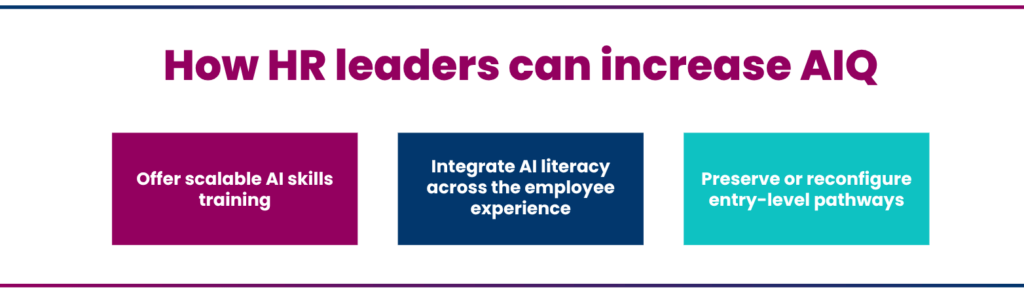
HR leaders can increase AIQ by:
- Offering scalable AI-skills training—covering prompt basics, critical evaluation of AI outputs, and governance—for all generations, not just digital natives.
- Integrating AI literacy into onboarding, leadership development, and performance goals so everyone is aligned around the importance of AI fluency and boosting their own capabilities.
- Preserving or reconfiguring entry-level pathways, enabling Gen Z talent—the highest-AIQ cohort—to pull the broader workforce forward.
It isn’t only about technology training, though. Skills like change management, communication, and effective team leadership become even more critical as AI adoption grows. As Chief Strategy Officer at Pearson Sulaekha Kolloru recently shared with the World Economic Forum:
“While the early focus of AI usage has been on what roles can be automated, sustained productivity benefits will come through people’s ability to harness the technology effectively. This will only be achieved by addressing the ‘learning gap’ between what AI tools can do and how well workforces can use them. The most successful organizations will invest in building the human capabilities that are essential for success—such as critical thinking, creativity, and discernment—alongside AI fluency.”
— Sulaekha Kolloru, Chief Strategy Officer, Pearson

AI in HR: augmentation, not replacement
AI delivers real value when it augments human judgment, accelerates decision-making, and frees people to focus on higher-impact work. When it is used prematurely as a cost-cutting tool, the result is often lost capability, damaged trust, and expensive course corrections.
HR leaders can hedge their workforce bets by investing in readiness across generations, resisting reductions that outpace proven AI performance, and building flexibility through interim and fractional talent. This approach allows organizations to capture AI’s upside while preserving the human capabilities like judgment, creativity, and relationship-building that customers and employees still expect and value.
In an era defined by uncertainty, the most resilient organizations will be those that treat AI as a force multiplier for their people, not a substitute for them.